Engine Cooling System Maintenance in Texas Heat: A Guide for Crandall and Canton TX Drivers
If you've read through our summer car maintenance checklist Forney TX guide, you already know that Texas summers are tough on vehicles across the board. But few systems take a harder hit than your engine's cooling system. When summer temperatures in East Texas routinely push past 100°F, your cooling system is working overtime to keep engine temperatures from climbing into dangerous territory. For drivers in Crandall, Canton, and the surrounding areas, understanding how each component of your cooling system holds up under that kind of heat, and knowing when something needs attention, can save you from an inconvenient breakdown on FM 1641 or Highway 198. This reference guide breaks down the full cooling system, component by component, so you know what to watch for, when to service it, and how to keep your vehicle running reliably through another Texas summer.
Why Engine Cooling System Maintenance in Texas Heat Is a Different Challenge
Most vehicle manufacturers design cooling systems to handle a wide range of operating conditions, but the recommendations in your owner's manual are written for average climate zones, not the sustained high heat of North Texas summers. The average high temperature in the Dallas: Fort Worth region exceeds 95°F for roughly 70 days each year, and East Texas humidity adds additional thermal stress by reducing the efficiency of heat dissipation around the engine bay.
Here's the core challenge: your engine generates an enormous amount of heat during normal operation, and the cooling system's entire job is to absorb that heat and release it into the air through the radiator. When ambient air temperatures are already high, the cooling system has to work harder to accomplish the same result. Components that might last 100,000 miles in a cooler climate may begin showing wear at 60,000 to 75,000 miles in a Texas driving environment. Hoses become brittle faster. Coolant breaks down sooner. Water pump bearings wear under prolonged thermal stress.
Engine cooling system maintenance in Texas heat isn't just about following the standard service schedule: it's about understanding that the climate here accelerates wear and adjusting your maintenance approach accordingly. Understanding car overheating causes Texas summer Forney TX is a good starting point, but this guide goes deeper into the components themselves so you can stay ahead of problems rather than react to them.
The Radiator: Your First Line of Defense Against Overheating
The radiator is the centerpiece of your cooling system. Hot coolant flows out of the engine, passes through the radiator's network of small tubes and fins, and sheds that heat into the airflow passing through your grille. In Texas summer conditions, that process happens continuously and rapidly, which creates two distinct maintenance concerns.
External Debris and Blockage
East Texas roads bring bugs, road dust, cottonwood seeds in early summer, and airborne debris that gradually clogs the small fins on the outside of your radiator. Even a 20-25% reduction in fin airflow can measurably reduce cooling capacity. Periodically inspecting the front of the radiator, and gently cleaning it with low-pressure air or water when needed, is an easy step many drivers skip. If you notice your temperature gauge creeping higher than normal on slow-moving highway traffic, a partially blocked radiator exterior is worth checking before assuming something mechanical has failed.
Internal Corrosion and Scale Buildup
Inside the radiator, the bigger concern is corrosion and mineral scale. Over time, degraded coolant becomes more acidic and begins attacking the metal and plastic components of the radiator. Scale deposits narrow the internal passages and reduce flow efficiency. This is why coolant flush intervals matter so much: old coolant causes damage that can lead to pinhole leaks, cracked end tanks, or reduced radiator capacity. Most shops recommend a cooling system flush every 30,000 miles or roughly every 2 to 3 years under normal conditions, but in high-heat climates like ours, staying toward the earlier end of that range is a reasonable choice.
Coolant: What's In Your System and Why It Degrades Faster Here
Engine coolant, sometimes called antifreeze, does much more than prevent freezing in winter. It raises the boiling point of the water in your cooling system, contains corrosion inhibitors that protect metal surfaces, and carries heat efficiently between the engine and the radiator. Fresh coolant typically has a boiling point of around 265°F when properly mixed and pressurized, compared to 212°F for plain water. That extra margin is critical in Texas summer driving.
Coolant Concentration and Mixing Ratios
Coolant is typically mixed at a 50/50 ratio with distilled water, which provides both the best boiling protection and the best corrosion inhibitor performance. Running a higher concentration of coolant, say, 70% antifreeze, actually lowers the boiling point slightly and can reduce heat transfer efficiency. Stick with the manufacturer-recommended ratio, which is most commonly 50/50.
How Often to Check Coolant in Texas Conditions
Coolant level and condition checks are more important in hot climates because evaporation and small leaks become apparent faster under thermal stress. Checking your coolant level monthly during summer months is a practical habit for Texas drivers, if you want a more detailed breakdown of recommended intervals, our article on how often check coolant Texas heat walks through exactly what to look for and how to interpret what you find. Always check coolant level when the engine is cold: never open a pressurized radiator cap on a hot engine.
The Thermostat: A Small Part With a Big Job
The thermostat is a small, spring-loaded valve that sits between the engine and the radiator. Its job is to block coolant flow until the engine reaches its optimal operating temperature, usually somewhere between 195°F and 220°F depending on the vehicle, and then open to allow coolant to circulate through the radiator.
In summer driving, thermostats are under constant demand. They cycle open and closed repeatedly as your engine temperature fluctuates, and over time the spring mechanism can weaken or the valve can stick. A thermostat that sticks closed is an overheating emergency: coolant can't reach the radiator and engine temperatures spike quickly. A thermostat that sticks open causes the engine to run cooler than intended, which reduces fuel efficiency and can affect how your heater works in winter, but it's less immediately dangerous.
Many mechanics recommend replacing the thermostat during a water pump or timing belt service since the parts are inexpensive and the labor is already being performed. For Kaufman County drivers who want to understand what happens when a thermostat goes bad during summer driving, we cover that scenario in detail in our post on bad thermostat driving summer Kaufman County. Thermostats typically cost very little as parts, making proactive replacement a reasonable maintenance decision for higher-mileage vehicles.
The Water Pump and Coolant Hoses: The Circulation Side of the System
Even the best radiator and cleanest coolant won't keep your engine cool if the coolant isn't moving. That's the water pump's job: it's a belt-driven or chain-driven impeller pump that keeps coolant circulating continuously through the engine block, cylinder head, heater core, and radiator.
Water Pump Warning Signs
Water pumps can fail in two ways: slow leaks from a worn shaft seal, and impeller failure where the pump stops moving coolant effectively. A coolant leak near the center of the engine (often described as weeping from a small hole called a "weep hole") is the most common sign of a shaft seal beginning to fail. Impeller failure is harder to detect but often shows up as overheating under load despite adequate coolant levels. Most water pumps are rated for 60,000 to 100,000 miles, but heat cycling in Texas conditions can push them toward the lower end of that range. If your vehicle uses a timing belt and you're approaching the replacement interval, it's common practice to replace the water pump at the same time since both components share labor costs.
Coolant Hoses
Coolant hoses are made of rubber, and rubber doesn't love sustained heat. Over time, hoses become hard and brittle externally while softening and collapsing internally. The upper radiator hose is one of the most common failure points: it's under the highest pressure and temperature and is easy to inspect visually. Squeeze the hose when the engine is cold: it should feel firm but slightly pliable. Cracking on the exterior surface, extreme softness, or a hard, stiff feel are all signs that replacement is overdue. Hose failures tend to happen suddenly, so if you're seeing any of those signs, don't wait on it.
The Expansion Tank: The Overlooked Component
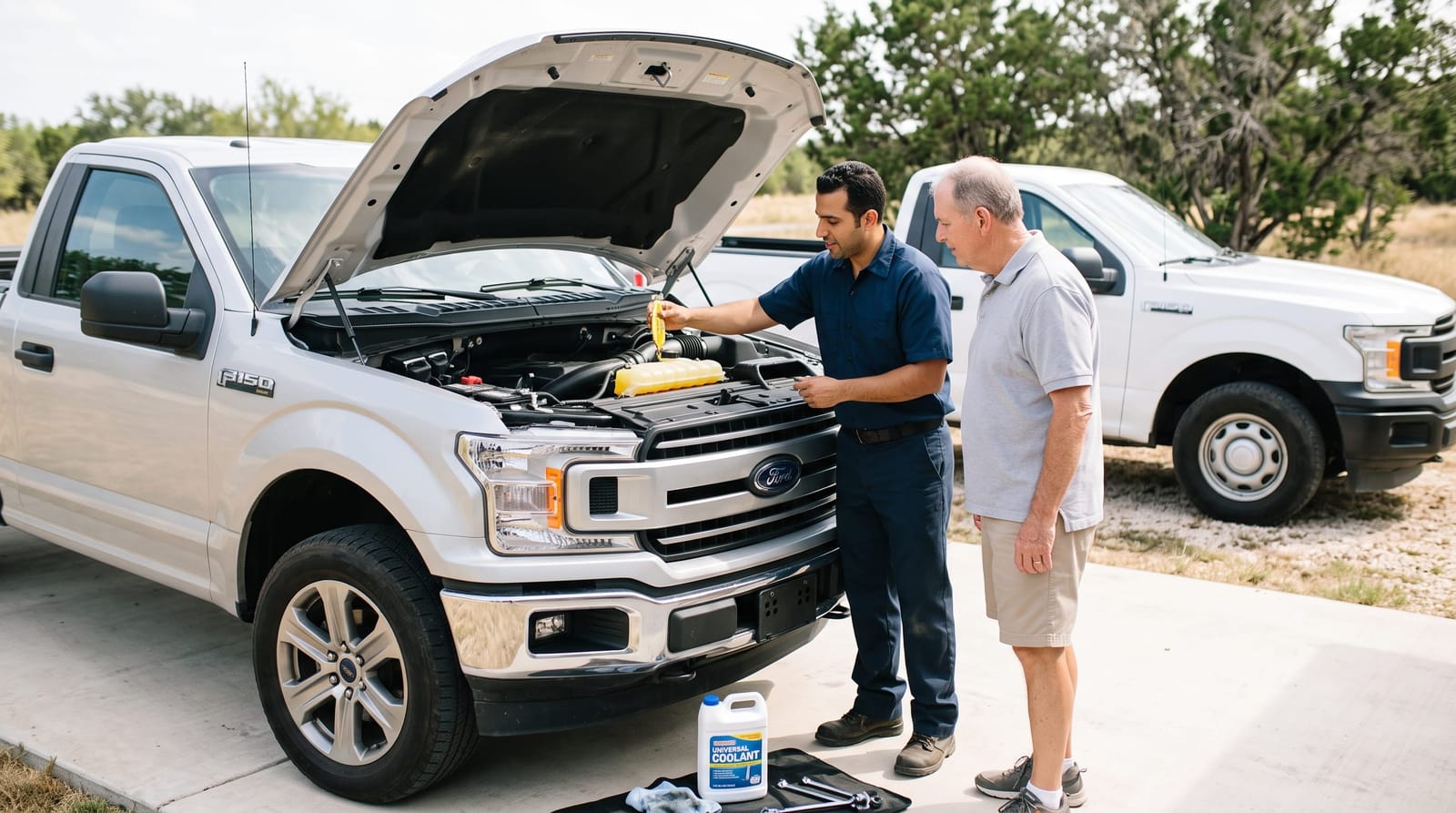
Most modern vehicles have a translucent plastic coolant reservoir, sometimes called the expansion tank or overflow bottle, that serves as a buffer for the cooling system. As coolant heats up and expands, excess fluid moves into this tank. As the engine cools, it draws that fluid back in. This design keeps the system full and pressurized without wasting coolant.
What many drivers don't realize is that the expansion tank itself can be a failure point. The plastic becomes brittle with age and heat exposure, and cracks can develop that cause slow coolant loss. The cap on the expansion tank (or on the radiator itself on older vehicles) maintains system pressure, typically between 13 and 16 PSI. A cap that no longer seals properly allows the boiling point advantage of pressurization to disappear, which can lead to boiling coolant at lower temperatures than designed. Caps are inexpensive to replace and are often tested during a cooling system inspection.
For drivers who also want to understand how heat stress affects other electrical systems, particularly your battery, our guide on car battery replacement heat damage Mesquite TX covers how Texas summers affect battery longevity and what warning signs to watch for there as well.
Service Intervals and Inspection Schedule for Hot Climate Driving
Pulling together all of the above, here's a practical reference for cooling system service intervals tailored to Texas driving conditions:
- Monthly (summer months): Visually check coolant level in the expansion tank. Look for any signs of leaks under the vehicle after it's been parked.
- Every 15,000 miles or annually: Have a shop perform a visual inspection of hoses, clamps, and the expansion tank. A pressure test can detect small leaks before they become larger problems.
- Every 30,000 miles or 2-3 years: Coolant flush and refill with fresh, manufacturer-approved coolant. This is also a good time to test the radiator cap and inspect the thermostat.
- Every 60,000-100,000 miles: Water pump inspection or replacement, particularly if it's being accessed during a timing belt or serpentine belt service.
- As needed: Hose replacement if any signs of cracking, softness, or hardening are present during inspection.
These intervals are general guidelines. Always refer to your vehicle manufacturer's recommendations, and let your service advisor know that you're in a high-heat climate so they can factor that into their inspection and recommendations.
For a broader look at how to prepare your entire vehicle for a Texas summer, not just the cooling system, check out our winter car preparation Kaufman County TX guide for the opposite end of the seasonal spectrum, covering what East Texas winters actually demand from your vehicle.
Conclusion: Don't Wait for the Temperature Gauge to Tell You There's a Problem
Your cooling system does quiet, continuous work every time you drive, and it's most stressed exactly when you need it most: stuck in slow traffic on a 103°F afternoon in Crandall or making the long drive out to Canton for the trade days. The good news is that most cooling system failures don't happen without warning. Keeping up with fluid checks, staying on top of flush intervals, and having hoses and the water pump inspected as your mileage climbs are all straightforward steps that pay off in reliability.
At Gregg Automotive, we understand the specific conditions East Texas drivers deal with, not just what the service manual says, but how our local climate affects the real-world lifespan of your vehicle's components. If you haven't had your cooling system inspected recently or you're noticing any warning signs, give us a call or stop by to schedule a cooling system inspection. We'll give you a straight answer about what your vehicle needs and what can wait.