How Often Should I Check My Coolant in Texas Weather?

If you've driven through a Texas summer, you already know the heat here is no joke. What you might not realize is that the same heat beating down on you is also working on the fluid keeping your engine from overheating. Coolant, sometimes called antifreeze, does a critical job year-round, but in a climate like ours, it needs more attention than the average vehicle owner typically gives it. This post breaks down how often to check your coolant, how to read what you're seeing, and when a simple top-off isn't enough.
How Often Should You Check Your Coolant in Texas?
A good general rule is to check your coolant level at least once a month. That's the standard recommendation for most vehicles, and it's a reasonable starting point. But in Texas, especially during the long stretch of triple-digit days from late May through September, checking every two weeks is a smarter habit.
Here's why the frequency matters more here than in, say, Minnesota: heat accelerates the breakdown of the chemicals in coolant that protect your engine. Over time, coolant loses its ability to regulate temperature effectively and can become more acidic. That acidity can start to wear on hoses, the radiator, and other cooling system components. The hotter your climate, the faster that process happens.
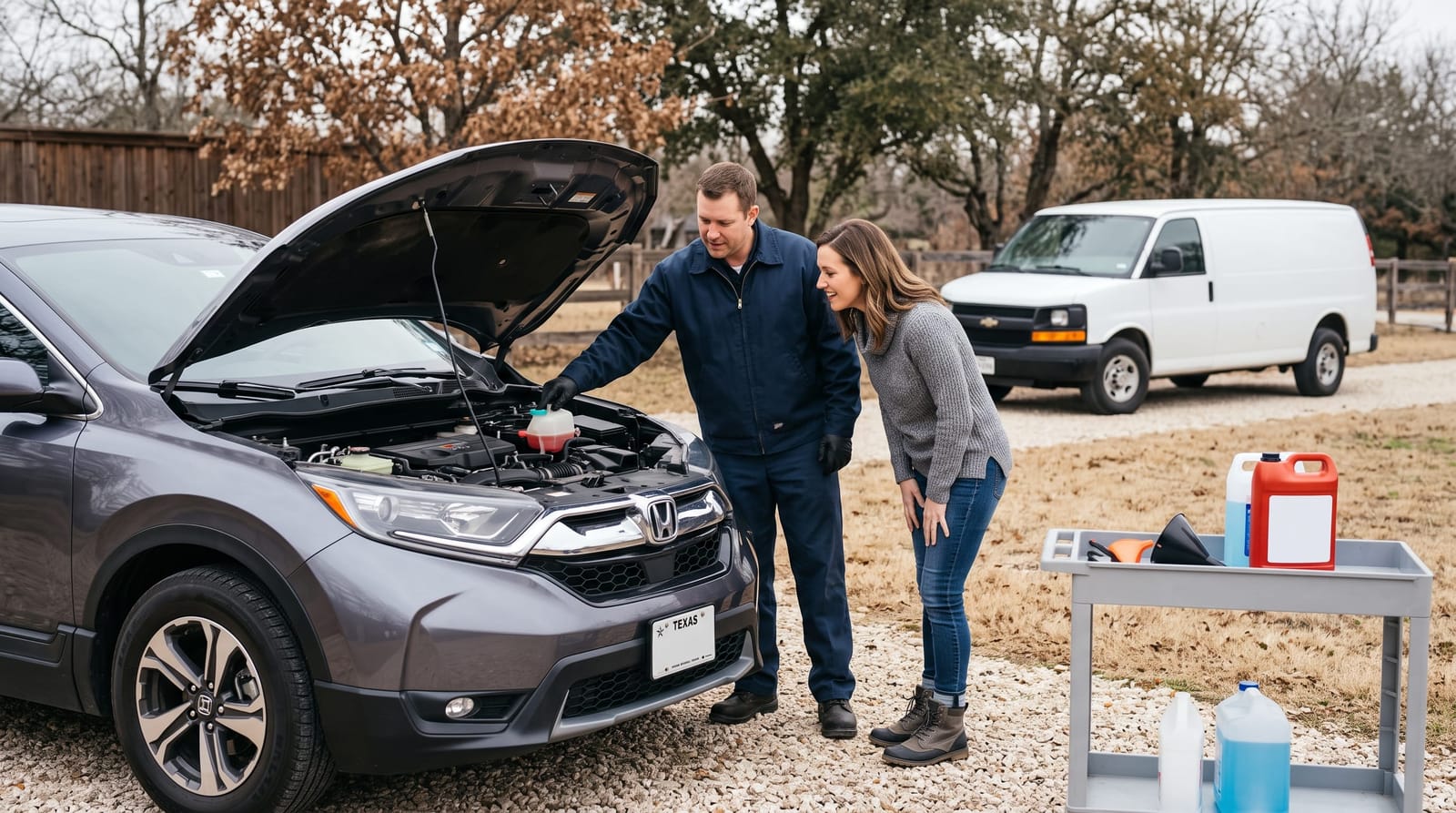
A practical approach for Forney and Kaufman County drivers is to make coolant checks part of your routine fuel stop habit. Every time you gas up, it takes less than two minutes to pop the hood and glance at the coolant reservoir. You're not looking for anything complicated, just checking the level against the MIN and MAX markers on the translucent plastic reservoir on the side.
Important safety note: Never open the radiator cap or the coolant reservoir cap when the engine is hot. Wait until the engine has been off for at least an hour, or check it cold before your first drive of the day. Hot coolant is pressurized and can cause serious burns.
How to Read Your Coolant: What Are You Actually Looking At?
Checking the level is the easy part. Understanding what you're seeing tells you whether a top-off or a full flush is in order.
Color and Clarity
Fresh coolant is bright: typically green, orange, pink, or blue depending on the type your vehicle uses. Healthy coolant looks translucent and clean when you look at it in the reservoir. If your coolant looks brown, rusty, or murky, that's a sign it's been in there too long or that something else is going on inside the cooling system. Brownish coolant often indicates the protective additives have worn down and the fluid may be picking up rust or debris.
Using an Inexpensive Coolant Tester
Most auto parts stores sell simple coolant test strips for just a few dollars. You dip the strip into the reservoir, wait a few seconds, and compare the color change to a chart on the packaging. These strips test the pH level of your coolant. When coolant becomes too acidic (low pH), it stops protecting your engine components the way it should. This is a straightforward test any driver can do at home, and in a hot climate, running a test every three months gives you a clear picture of where your coolant stands.
If you want a more precise reading, a coolant hydrometer or refractometer can tell you the freeze protection level of your coolant, which also reflects the concentration of antifreeze in the mix. Even though hard freezes are rare in East Texas, the concentration matters for boiling protection too. A properly mixed coolant raises the boiling point, which is exactly what you need during a July afternoon.
Top Off or Full Flush: How Do You Know Which One You Need?
This is where a lot of drivers get confused, so let's keep it straightforward.
When Topping Off Is Appropriate
If your coolant level is slightly low but the fluid looks clean and clear, topping it off with the correct type of coolant for your vehicle is a perfectly fine short-term step. Check your owner's manual or the label on your current reservoir to confirm the coolant type: mixing different formulas can cause problems. Distilled water can be used in a pinch to bring the level up, but follow up with the proper coolant mix as soon as possible.
Keep in mind that coolant shouldn't disappear on a regular basis. If you find yourself topping it off frequently, that's worth having looked at: coolant loss usually points to a leak somewhere in the system.
When a Full Flush Is the Right Call
A coolant flush involves draining the old fluid completely, flushing the system with water to clear out built-up deposits, and refilling with fresh coolant. Most manufacturers recommend a flush every 30,000 to 60,000 miles, but in Texas heat, leaning toward the shorter end of that range is wise. You should also consider a flush if:
- Your coolant looks brown, rusty, or has visible particles floating in it
- Your test strip shows the pH is outside the acceptable range
- It's been more than two years since the last flush regardless of mileage
- You've had any cooling system repairs that may have introduced contaminants
Understanding this distinction also matters in the context of other cooling system issues. If your vehicle is already running hot, it's worth reading about car overheating causes Texas summer Forney TX to understand the full picture: a coolant flush alone won't solve a problem rooted in a failing component.
Signs Your Coolant Is Breaking Down Between Checks
Monthly checks are great, but your vehicle can give you signals in between that something is off with the cooling system. Watch for these indicators:
- Temperature gauge climbing higher than normal: If your gauge is consistently running closer to the hot side during regular driving, that's worth investigating promptly.
- Sweet smell from the engine bay: Coolant has a distinctive sweet odor. If you smell it while the engine is running or after you park, you may have a small leak.
- Visible residue near hoses or fittings: Dried coolant often leaves a crusty, whitish-pink or greenish residue near connection points. This is a sign of a slow leak that deserves attention.
- Heater not working properly: This can seem counterintuitive, but your heater uses hot coolant to generate warm air inside the cabin. If the heat is weak, low coolant level or a circulation issue can be the cause.
It's also worth knowing that a faulty thermostat can cause your engine to run hot even when coolant levels are fine. If you're seeing temperature fluctuations and your coolant checks out, a bad thermostat in summer conditions is another possibility to look into.
Frequently Asked Questions
Can I just use water instead of coolant if I'm in a pinch?
Distilled water can temporarily bring your coolant level up if you're in a bind and the proper coolant isn't available. However, water alone doesn't have the additives that protect against corrosion, and it doesn't raise the boiling point the way a proper coolant mix does. This should only be a short-term fix. Get the right coolant in there as soon as reasonably possible.
Does the type of coolant matter for Texas heat?
Yes. Different vehicles require different coolant formulas: typically categorized as IAT (older green formula), OAT (orange, pink, or red, common in newer vehicles), or HOAT (a hybrid blend). Using the wrong type can cause the additives to interact poorly and reduce the fluid's effectiveness. Your owner's manual will specify what your vehicle requires, and your shop can help confirm the right choice.
How do I know if my coolant is properly mixed?
The standard mix is a 50/50 ratio of coolant concentrate and distilled water. This mixture is optimized for both freeze protection and, more relevant for Texas, boil-over protection. A refractometer or test strip can help you verify the concentration. Pre-mixed coolant sold at auto parts stores is already at the 50/50 ratio, which makes it convenient if you're unsure.
Is it normal for coolant level to drop slightly over time?
Very minor, gradual drops in coolant level over a long period aren't uncommon as systems age. However, if you're noticing a consistent drop month to month, that's not something to brush off. Coolant doesn't burn off the way oil can: a steady decrease usually points to a leak somewhere in the system, even a small one that isn't visible yet.
Keeping Your Cooling System Healthy Through a Texas Year
Coolant is one of those things that's easy to forget about until a problem shows up. The good news is that a basic check takes almost no time and can give you real peace of mind, especially before long summer drives or road trips. Check the level monthly, do a quick visual and test strip check every few months, and follow your manufacturer's flush interval (erring toward 30,000 miles in our climate). If something looks off, bring it in before it becomes a bigger issue. At Gregg Automotive, we're happy to take a look and give you a straight answer on where your cooling system stands.