Differential Service for Trucks in Canton TX: What It Is and When You Need It
If you own a truck or SUV in the Canton area, you probably rely on it for more than just commuting. Whether you're hauling equipment, towing a trailer, or navigating the back roads around Kaufman County, your drivetrain takes a real workout. One part of that drivetrain that often goes unnoticed until something goes wrong is the differential. This post breaks down what differential service is, how often it's needed, and why staying on top of it matters for Canton TX truck owners who put their vehicles to work.
What Is a Differential and What Does It Do?
The differential is a mechanical assembly that allows your wheels to rotate at different speeds while still receiving power from the engine. This matters more than you might think. When you turn a corner, your outside wheels travel a longer distance than your inside wheels. Without a differential, your tires would scrub and skip through every turn, and the added stress on the drivetrain would be significant.
Most trucks have at least two differentials: one in the rear axle and, on four-wheel-drive vehicles, one in the front axle as well. Some trucks also include a center differential as part of the transfer case system. Each of these units contains a set of gears that need lubrication to function properly. That lubrication comes from differential fluid, also called gear oil, which coats the internal gears and bearings to reduce friction and carry away heat.
Over time, that fluid breaks down. It absorbs moisture, picks up metal particles from normal gear wear, and loses its ability to protect those internal components. When that happens, the gears run hotter and wear faster than they should. Differential service simply means draining the old fluid and replacing it with fresh gear oil that meets your manufacturer's specifications.
How Often Does Differential Fluid Need to Be Changed?
Most manufacturers recommend changing differential fluid somewhere between every 30,000 and 60,000 miles under normal driving conditions. However, trucks and SUVs used for towing, hauling, or frequent off-road driving often need service closer to the 30,000-mile mark: sometimes sooner. Heat is the biggest enemy of gear oil, and heavy-duty use generates a lot of it.
For drivers in Canton TX and the surrounding rural areas of Kaufman County, "normal driving conditions" often doesn't apply. If you're regularly towing a stock trailer, running through fields, or hauling heavy loads to job sites, your differential is working harder than average. Industry data suggests that towing near or at a vehicle's rated capacity can shorten the effective life of differential fluid by as much as 40 to 50 percent compared to light-duty use.
It's also worth noting that if your truck has ever been through standing water, like during a creek crossing or a flooded road, the differential housing can draw in moisture past the seals. Water-contaminated gear oil appears milky or foamy rather than its normal dark amber or brown color. If you notice that, it's worth having it checked sooner rather than waiting for the next scheduled interval.
Always check your owner's manual for the manufacturer's specific recommendation for your truck's make, model, and axle configuration. Service intervals can vary significantly depending on the type of differential and whether it uses a limited-slip additive.
Signs Your Differential May Need Attention
Differential problems don't always announce themselves loudly, at least not at first. Here are some of the more common signs that something is off:
- Whining or humming noise from the axle area: A steady hum or whine that changes with vehicle speed can indicate worn gear surfaces or low fluid levels. This is often one of the earliest signs of differential wear.
- Clunking when accelerating or decelerating: A clunk felt through the drivetrain, especially when power is applied or released, can point to excessive gear wear or worn spider gears inside the differential.
- Vibration at highway speeds: While vibration has many possible causes, differential issues can contribute to a noticeable shudder, particularly under load.
- Fluid leaking from the axle housing: A dark, oily residue around the differential cover or axle seals typically means a leak. Low fluid from a leak accelerates internal wear significantly.
- Handling that feels unusual during turns: On vehicles with limited-slip differentials, a worn or improperly serviced unit can cause the vehicle to behave unexpectedly when cornering.
If you notice any of these symptoms, having the differential inspected sooner is a practical step. Catching a minor fluid or seal issue early is far less involved than addressing gear damage that develops from running a differential on degraded or low fluid for an extended period.
What Happens During a Differential Service?
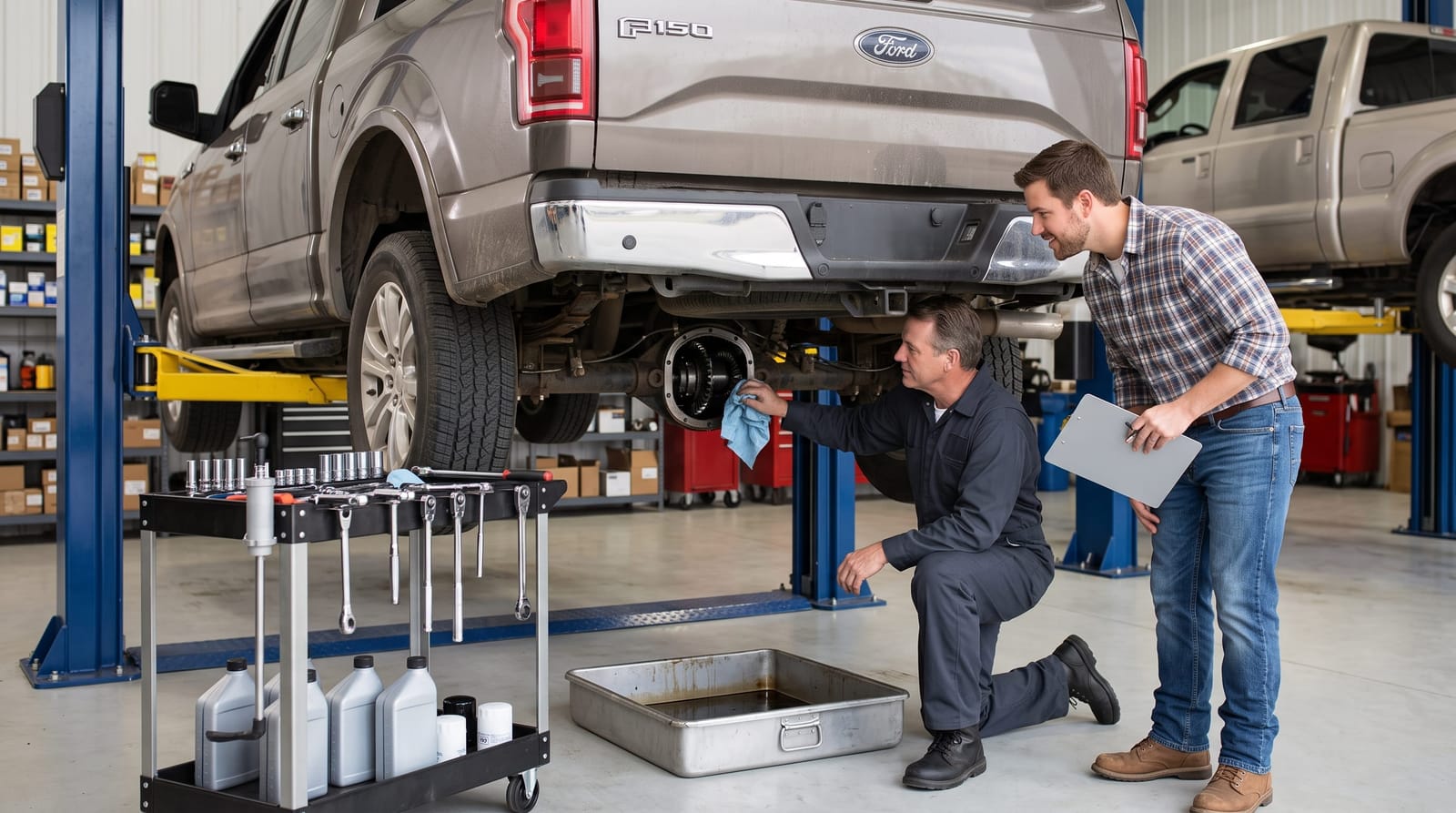
A standard differential service is a straightforward maintenance procedure. Here's what it typically involves:
- The technician removes the differential cover or drain plug and drains the old fluid completely.
- The inside of the housing is inspected for metal shavings or debris: a small amount of fine metallic particles is normal, but larger chunks indicate significant wear.
- The gasket or cover sealing surface is cleaned before reinstallation to prevent leaks.
- Fresh gear oil is added to the correct fill level. The type and viscosity of oil varies by axle: your technician will use the specification that matches your truck's differential.
- On limited-slip differentials, a friction modifier additive is typically included with the new fluid. Skipping this step can cause the limited-slip clutch packs to chatter during turns.
The service itself usually takes less than an hour. If the differential cover gasket needs replacement or if there's a leaking axle seal that needs to be addressed, that adds some time. A good shop will let you know what they find during the inspection before proceeding with any additional work.
If your truck is also due for a transfer case fluid change Forney TX service, it's often efficient to have both done together, since they're related parts of the same four-wheel-drive system and require similar access.
Why Skipping Differential Service Causes Larger Problems
Differential internals, ring gears, pinion gears, spider gears, and bearings, are precision components that depend on proper lubrication to maintain tight tolerances. When the fluid degrades and those tolerances begin to suffer, the damage compounds quickly. Studies from fleet maintenance programs have found that deferred differential service is among the leading causes of preventable axle failures in work trucks, with repair costs averaging 5 to 10 times the cost of the fluid change that could have prevented the problem.
For a truck that earns its keep in Kaufman County, whether that's ranch work, construction, or just everyday rural driving, an unexpected differential failure means downtime. A fluid change every 30,000 to 60,000 miles is a small investment compared to the cost and inconvenience of a major axle repair.
Frequently Asked Questions
How much does a differential fluid change typically cost?
The cost varies depending on the vehicle, the number of differentials being serviced, and whether the unit requires a special limited-slip additive. Front and rear differential services are typically priced separately. Getting an estimate from your local shop for your specific truck is the best way to get an accurate figure, since pricing depends on vehicle type and current parts costs.
Do I need to service both the front and rear differential?
On a four-wheel-drive truck, yes: both the front and rear axle differentials have their own fluid and should be serviced according to their respective service intervals. They may not need to be done at the exact same mileage, but both should be on your maintenance schedule. Ask your technician to check both during your next service visit.
Can I tell if my differential fluid is bad just by looking at it?
To some extent. Fresh gear oil is typically a dark amber or brownish color with a distinctive sulfur-like smell. Fluid that's gone bad may appear very dark or black and may have a burnt odor. Fluid that looks milky or foamy is a sign of water contamination. However, the best assessment comes from a technician who can also inspect the housing for debris and check the seals for leaks.
Is differential service the same as a transfer case service?
No, though they're related. The differential is located in each axle and manages power distribution between the wheels on that axle. The transfer case is a separate unit that routes power between the front and rear axles on four-wheel-drive vehicles. Both have their own fluid and their own service intervals. It's common for shops to recommend servicing them around the same time since they're part of the same drivetrain system.
Keeping Your Truck Ready for the Work Ahead
For truck owners in Canton TX and across rural Kaufman County, the differential is one of those components that works hard in the background without getting much attention, until something goes wrong. Staying on top of differential service every 30,000 to 60,000 miles, or more frequently if you tow or haul regularly, is one of the more straightforward ways to protect the long-term reliability of your drivetrain. It fits naturally into the broader goal of keeping a working truck performing the way it should, which is what this whole cluster of performance and maintenance topics is really about. If you're not sure when your differentials were last serviced, it's worth asking at your next oil change.