The Complete Truck and SUV Performance Guide for Kaufman County Drivers
If you drive a truck or SUV in Kaufman County, chances are your vehicle does more than just get you from one place to another. It hauls equipment to a job site in Crandall. It pulls a horse trailer down FM 429 outside of Canton. It carries feed and fencing supplies through the back roads of Terrell. Out here, a truck isn't an accessory: it's a working tool, and it needs to perform when it matters most.
That's why performance isn't just a word reserved for racetracks or car shows. For working truck and SUV owners in East Texas, performance means reliability, towing confidence, off-road readiness, and the kind of long-term durability that holds up under real use. When something isn't working right, when the truck pulls under load, when the brakes feel soft with a trailer attached, or when the ride has gotten rough on uneven terrain, it affects your work, your schedule, and your safety.
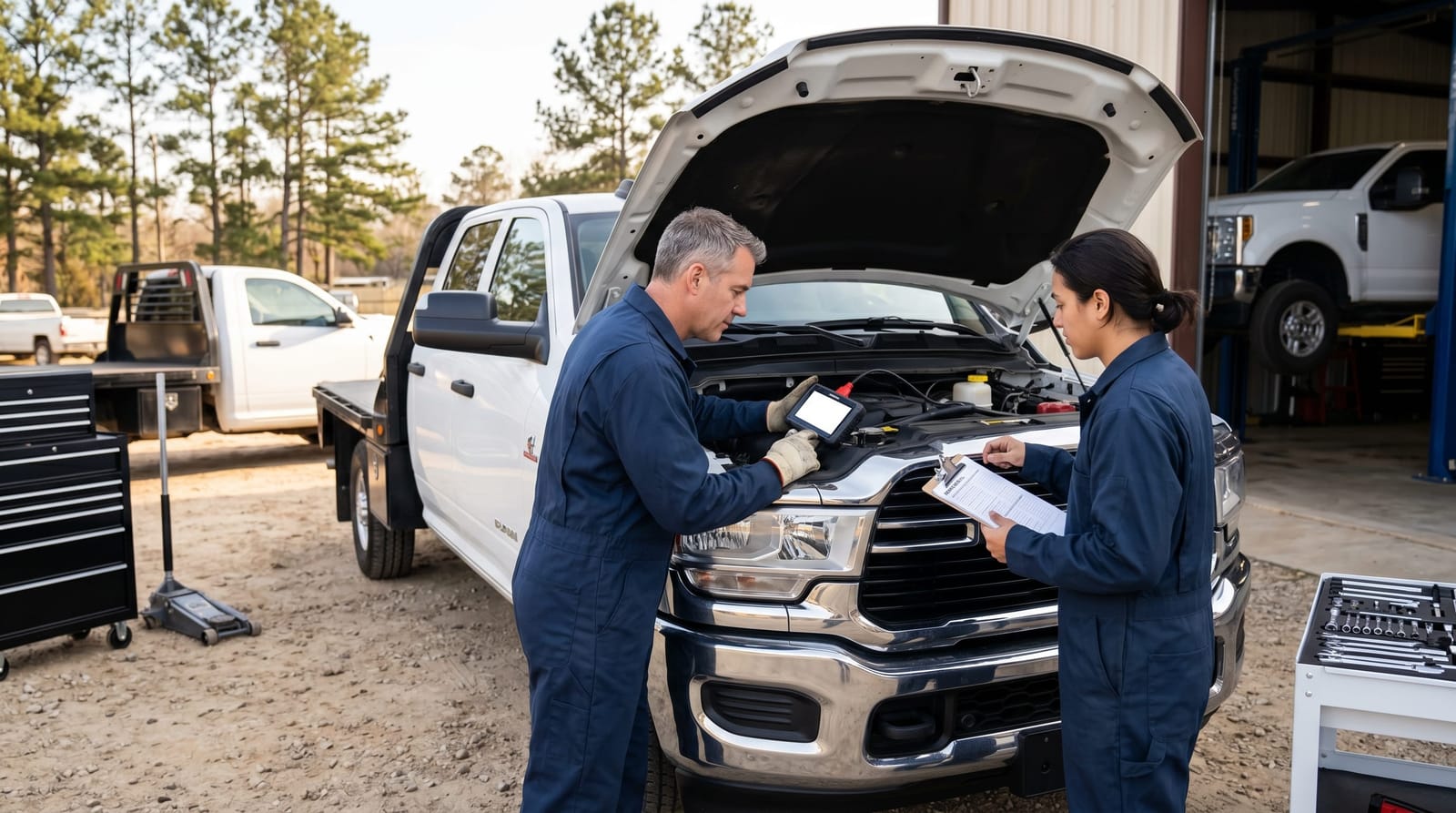
This guide was built specifically for drivers in Kaufman County and the surrounding communities of Forney, Terrell, Canton, Crandall, and beyond. Whether you own a half-ton gas pickup, a diesel work truck, or a body-on-frame SUV, you'll find practical information here covering suspension health, engine maintenance, brake systems, drivetrain care, and how all these systems work together. Consider this your go-to reference for keeping your truck operating at its best, from the chassis up.
If you're looking for a truck performance shop in Kaufman County, TX that understands the demands of working vehicles in this region, Gregg Automotive is built for exactly that kind of customer.
Why Truck Performance Maintenance Is Different From Regular Car Service
There's a meaningful difference between maintaining a sedan driven mostly on city streets and maintaining a truck that spends its week hauling, towing, and navigating rural terrain. Trucks and body-on-frame SUVs carry more weight, operate under greater mechanical stress, and are often asked to perform in conditions that most passenger vehicles never see. That means every major system, engine, suspension, brakes, and drivetrain, has to be evaluated with those demands in mind.
According to data from the Federal Highway Administration, Texas consistently ranks among the top states for registered work trucks and commercial-use pickups. In rural counties like Kaufman, where agriculture, construction, and trades work is embedded in daily life, that concentration is even more pronounced. These aren't vehicles sitting in a garage: they're logging 20,000 to 30,000 miles or more per year under genuine load.
What this means practically is that maintenance intervals, wear patterns, and service priorities are different for a truck that tows a loaded trailer twice a week versus one that rarely leaves smooth pavement. Brake components wear faster under towing loads. Suspension components compress and flex far more frequently when a truck is regularly loaded near its gross vehicle weight rating. Engine and transmission temperatures run higher during extended towing on Texas highways in summer heat.
Understanding your truck as a system, and recognizing how each component affects the others, is the foundation of good truck ownership. When you bring your vehicle to a shop that specializes in trucks and SUVs, rather than a general-purpose oil change chain, you're getting service from technicians who understand those interactions. That kind of knowledge is what separates a good truck shop from a basic maintenance facility.
The "Working Load" Factor
One concept worth understanding is what we call the working load factor: essentially how often and how hard your truck is operating near its rated capacity. A truck rated to tow 12,000 pounds that regularly tows 10,500-pound loads is working at roughly 87% of its rated capacity. At that level, heat buildup, brake fade risk, and suspension fatigue are all elevated compared to lighter-duty use. Knowing your typical working load helps a technician make better recommendations about inspection intervals and which components deserve closer attention.
Suspension Health: The Foundation of Towing and Off-Road Performance
The suspension system is one of the most overlooked contributors to truck performance, and one of the most important. When your suspension is in good shape, your truck handles predictably, distributes load evenly across the frame, and gives the driver accurate road feedback. When it's worn or damaged, towing becomes unpredictable, off-road driving gets rougher, and tire wear accelerates in ways that cost you money over time.
For Kaufman County drivers, suspension takes a beating from both directions: loaded work use and rough road conditions. County roads, unpaved ranch access paths, and uneven terrain around the area put consistent stress on ball joints, tie rods, shocks, struts, and leaf springs. Most truck owners don't notice suspension wear until it's severe because it happens gradually: a little more bounce, a little more wander in the steering, a slightly rougher ride. By the time it's obvious, significant wear has usually already occurred.
Suspension Components Worth Knowing
- Shocks and struts: These control how your truck absorbs and recovers from bumps. Worn shocks increase stopping distance: studies have shown that vehicles with worn shock absorbers can require up to 10 feet more stopping distance at highway speeds. For a loaded truck, that difference matters enormously.
- Ball joints: These connect the steering knuckles to the control arms and allow the suspension to move. Worn ball joints create looseness in the steering and, in extreme cases, can separate unexpectedly.
- Leaf springs: Common on the rear of most work trucks, leaf springs can sag, crack, or lose tension over years of heavy hauling. A sagging leaf spring means your truck sits lower than designed, which affects towing angle and tongue weight distribution.
- Sway bar links and bushings: These reduce body roll during turns. Worn bushings are often the cause of clunking or rattling sounds over bumps.
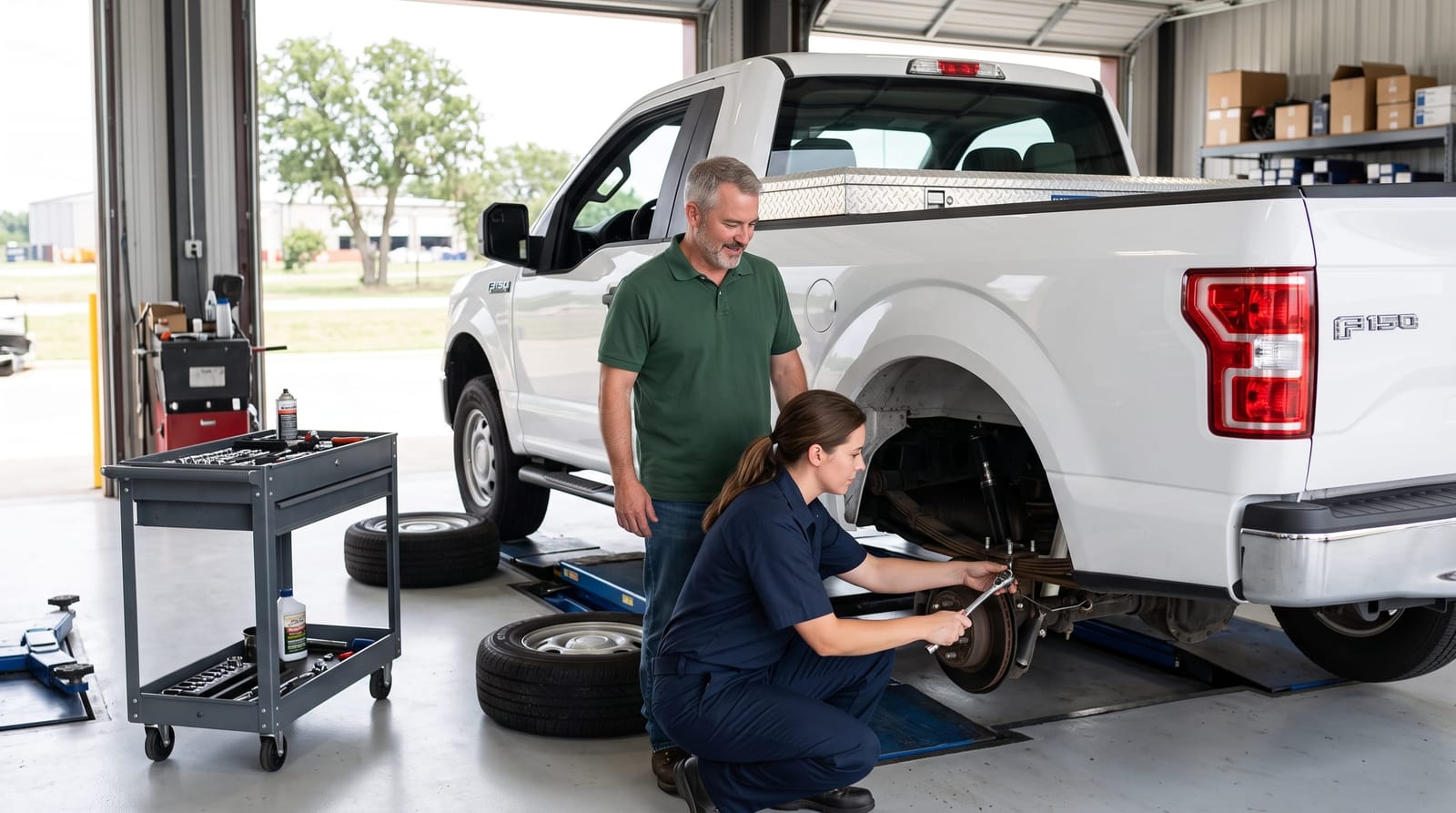
For a deeper look at keeping your suspension in working condition, see our guide on truck suspension maintenance Kaufman County: it covers what to inspect, when to service, and how suspension choices affect both ride quality and towing stability.
Engine Maintenance for High-Mileage Trucks: What East Texas Owners Need to Know
Many trucks in Kaufman County are high-mileage vehicles, and that's not a problem if they've been maintained well. Modern truck engines, whether gas or diesel, are designed to last well beyond 200,000 miles with proper care. The issue isn't mileage itself; it's whether maintenance has kept pace with use.
High-mileage trucks benefit most from consistent attention to fluids, filters, and ignition components. Oil breaks down more quickly in engines operating under load, especially in Texas summers where ambient temperatures can push engine operating temperatures higher. Most manufacturer recommended oil change intervals were developed under average driving conditions: frequent towing or hauling qualifies as severe-duty use, which often warrants more frequent service.
Key Engine Service Points for Working Trucks
Air filtration: Trucks operating on dusty ranch roads or unpaved surfaces load up air filters faster than highway-driven vehicles. A clogged air filter reduces combustion efficiency and, over time, can allow debris to enter the intake system. Checking and replacing air filters based on actual operating conditions, not just mileage, is especially important in agricultural areas.
Fuel system health: Fuel injectors, throttle bodies, and fuel filters accumulate deposits over time. In high-mileage trucks, this shows up as rough idle, hesitation under acceleration, or reduced fuel economy. A professional fuel system cleaning can restore performance that's been lost gradually over tens of thousands of miles.
Coolant system: Towing puts sustained heat load on the engine. The cooling system, including the radiator, thermostat, coolant hoses, and water pump, needs to be in top condition to handle those demands. Coolant degrades over time and loses its ability to prevent corrosion inside the engine block. Most manufacturers recommend a full coolant flush every 30,000 to 60,000 miles depending on the type used.
Spark plugs and ignition components (gas engines): Worn spark plugs reduce combustion efficiency and can cause misfires under load. For gas trucks doing regular towing, fresh plugs can make a noticeable difference in throttle response and fuel economy. Most modern iridium plugs are rated for 60,000 to 100,000 miles, but high-load use warrants inspection before that interval is up.
If your gas truck has been running a bit rough or you've noticed a drop in fuel economy over the last several thousand miles, our post on engine tuneup high mileage truck Terrell TX walks through exactly when and why a tuneup makes sense for trucks in this region.
Gas vs. Diesel: Maintenance Differences That Affect Performance
Kaufman County has a healthy mix of gas and diesel truck owners, and while both types of trucks can be highly capable, they require different maintenance approaches to stay that way. Understanding those differences helps you stay ahead of service needs and avoid the kind of deferred maintenance that shortens engine life.
Diesel engines are known for high torque output at low RPMs, which makes them especially well-suited for heavy towing and hauling. However, they require more complex maintenance, particularly around fuel system components, emission control systems, and oil service. Diesel engine oil is typically changed at 5,000 to 7,500-mile intervals under severe-duty use, and the fuel filters, often a dual-filter setup on modern diesels, need regular attention to keep injection pressure within spec.
Gas trucks are generally simpler to maintain and have lower upfront service costs, but they benefit significantly from keeping ignition, fuel delivery, and cooling systems fresh. Under consistent towing use, a gas engine works harder in terms of RPM than a diesel doing the same job, which means heat management and fluid quality are especially important.
One area where both engine types overlap is transmission care. Automatic transmissions in tow-capable trucks run hot under load, and transmission fluid degrades faster in severe-duty use. Many transmission failures in high-mileage work trucks trace back to extended fluid change intervals. Most technicians recommend transmission fluid service every 30,000 to 45,000 miles for trucks doing regular towing, regardless of whether the owner's manual lists a longer interval.
Our detailed breakdown of diesel truck maintenance Forney TX covers the specific service requirements and performance considerations for diesel owners in this part of East Texas.
Brake Systems: Matching Stopping Power to What You're Pulling
Brakes are one of the most safety-critical systems on any vehicle, and for trucks that regularly tow or haul heavy loads, they deserve special attention. Stock brake systems are engineered to handle the vehicle at its rated capacity, but brakes that were adequate when new may not perform the same way after 60,000 or 80,000 miles of heavy-duty use.
Brake fade is a real concern for towing trucks. When brake components, rotors, pads, and fluid, absorb more heat than they can dissipate quickly, stopping power decreases temporarily. This is most likely to happen on long descents, during repeated stops from highway speed with a trailer attached, or in stop-and-go traffic while hauling a heavy load. Most drivers don't experience dramatic brake failure; instead, they notice the pedal feeling slightly less firm or requiring more effort to achieve the same deceleration.
Signs Your Brakes Need Attention
- Increased pedal travel before braking engages
- Soft or spongy pedal feel, especially after extended towing
- Squealing, grinding, or pulsation during braking
- Truck pulling to one side when braking
- Longer stopping distances than you're used to
Brake pads on trucks used for regular towing typically wear 30 to 50 percent faster than on vehicles used for standard commuting, according to data from brake component manufacturers. Rotors can also warp under repeated heat cycles from heavy towing, leading to the vibration or pulsation some drivers feel through the pedal.
Upgraded brake components, including higher-rated rotors and pads designed for heavy-duty use, are available for most popular truck platforms and can provide improved fade resistance and longer service life for trucks that regularly operate under load. These aren't racing components; they're purpose-built for work-truck demands.
For a complete breakdown of brake upgrade options and what makes sense based on your towing weight and frequency, visit our guide on truck brake upgrade towing Forney TX.
4WD and AWD Systems: Keeping Off-Road Capability Ready When You Need It
A four-wheel-drive system that isn't maintained properly is one of the most frustrating problems a truck owner can run into, because it usually shows up at exactly the wrong moment. Whether you're pulling out of a muddy field in Canton, navigating a flooded low-water crossing east of Terrell, or getting off-road in conditions that require real traction, your 4WD system needs to be in working condition to do its job.
The most common 4WD issues in high-mileage trucks stem from neglected transfer case fluid and front differential fluid. These fluids break down over time and lose their ability to properly lubricate the gears, bearings, and clutch packs inside the system. When that happens, engagement can become rough or intermittent, and internal wear accelerates. Transfer case fluid is often recommended for replacement every 30,000 miles, but many trucks reach well beyond that without any service.
Part-time 4WD systems, common on traditional body-on-frame trucks, also have engagement mechanisms (manual locking hubs or electronic actuators) that benefit from periodic use and inspection. A system that sits in 2WD mode for months at a time without ever being engaged can develop sticky or slow-responding components that create problems when you finally need them.
All-wheel-drive systems found on many SUVs are designed to operate continuously, but they still require differential fluid maintenance and attention to any warning lights that indicate engagement or traction control issues. Many AWD vehicles also use a rear differential coupler or clutch pack that wears over time and can cause shuddering or vibration if it's been neglected.
For a thorough look at maintaining your truck or SUV's four-wheel or all-wheel-drive system, our post on 4WD system maintenance Kaufman County TX covers the full picture, from fluid service to common failure points and how to tell when something needs attention.
How Your Truck's Systems Work Together: and Why That Matters
One of the most important things to understand about truck performance is that no single system operates in isolation. Suspension, engine, brakes, and drivetrain are all interconnected, and a problem in one area creates downstream effects on the others. This is especially true when modifications are involved, but it applies equally to stock trucks with normal wear patterns.
Consider a truck with a worn rear suspension. When that truck is loaded with a heavy payload, the rear sits lower than designed, which changes the trailer hitch angle and can affect tongue weight distribution. A poorly distributed tongue weight affects how the trailer tracks and how the truck's brakes respond. The truck may also be working harder aerodynamically, which affects fuel economy and engine load. A suspension problem that seems purely mechanical can, in this way, have real implications for towing safety and efficiency.
Similarly, engine and transmission health affect how the drivetrain responds to load. A transmission that's shifting sluggishly or running hotter than normal puts additional stress on the drivetrain components. An engine running on worn spark plugs may hesitate under heavy acceleration, causing the driver to demand more throttle input, which generates more heat throughout the drivetrain.
Modifications and Stock Systems
Modifications, like lift kits, larger tires, or aftermarket tuners, change the balance of a stock system and need to be accounted for across the entire vehicle. A 3-inch lift with larger-diameter tires changes the effective gear ratio, which affects acceleration, fuel economy, and transmission temperature. Larger tires also add rotational weight, which increases braking distance if brake components haven't been upgraded to match. A shop that understands trucks as complete systems can help you understand these interactions before making changes, so you get the performance you're looking for without creating problems elsewhere.
This is part of what makes working with a dedicated truck performance shop in Kaufman County, TX worth the investment, not just getting individual parts replaced, but getting service from technicians who think about how everything works together under your specific conditions.
Finding the Right Truck Shop in Kaufman County
Not every auto repair shop is equipped to handle the needs of serious working trucks. General maintenance facilities can handle oil changes and basic service, but when it comes to suspension work under a loaded truck, brake upgrades for towing applications, or diagnosing intermittent 4WD engagement issues, you want a shop with hands-on experience in that specific type of work.
Kaufman County has a range of service options, from dealerships like Paul Murrey Ford in Kaufman that offer factory-level service for Ford truck owners, to local shops serving the general auto repair market. For owners who need specialized truck and SUV performance work, particularly around suspension, drivetrain, towing-related brake service, and high-mileage engine maintenance, finding a shop with a specific focus on trucks makes a real difference.
When evaluating a truck shop, here are a few practical questions worth asking:
- Do they have experience with your specific truck platform (half-ton, three-quarter-ton, diesel, etc.)?
- Can they inspect suspension and brake systems with your typical payload in mind, not just on an empty vehicle?
- Are they familiar with how common modifications, lift kits, larger tires, aftermarket tuners, interact with your stock systems?
- Do they explain what they found and why they're recommending service, rather than just handing you a repair order?
At Gregg Automotive, we serve truck and SUV owners throughout Kaufman County and the surrounding communities because this is where we work and where our customers live. We understand the kind of use these vehicles see, and we give honest recommendations based on what we actually find, not a standard list of upsells. If your truck is working hard for you, we want to make sure it stays ready to do that for a long time.
Deep Dive Topics: Explore the Full Resource Library
This guide gives you a broad foundation for understanding truck and SUV performance, but each topic below goes deeper into specific systems and service areas relevant to Kaufman County drivers. Use these resources to get detailed, actionable information on the areas most relevant to how you use your vehicle.
-
Suspension Health for Working Trucks
A complete look at how truck suspension systems wear under real load conditions, what components to prioritize for inspection, and how good suspension health supports both towing and off-road driving. See our guide on truck suspension maintenance Kaufman County. -
Diesel vs. Gas Truck Maintenance
A side-by-side breakdown of what diesel and gas truck owners need to do differently to keep their engines performing well over the long haul, including service intervals, fluid requirements, and the unique challenges of each engine type. Read more about diesel truck maintenance Forney TX. -
Engine Tuneup for High-Mileage Trucks
Covers the specific tuneup services that make the biggest difference for trucks with 100,000 miles or more, when to schedule them, and what to expect from the process. Explore our post on engine tuneup high mileage truck Terrell TX. -
4WD and AWD System Maintenance
A focused guide on keeping four-wheel-drive and all-wheel-drive systems ready for the terrain and conditions common in Kaufman County, including what fluids matter, how to recognize early problems, and what regular service looks like. Learn more about 4WD system maintenance Kaufman County TX. -
Towing Capacity and Brake Upgrades
Everything you need to know about how towing weight affects brake performance, when stock brakes are no longer adequate for your load, and what upgrade options exist for trucks regularly operating near their towing capacity. See the full guide on truck brake upgrade towing Forney TX.
Conclusion: Taking Care of a Truck That Takes Care of You
A working truck is one of the most valuable tools a person in Kaufman County can own, and like any tool, it performs best when it's maintained with the same care it's asked to give. That means staying ahead of suspension wear before it affects your towing stability. It means keeping your engine and transmission serviced at intervals that match your actual use, not just the standard mileage markers. It means making sure your brakes are up to the job every time you hook up a trailer.
None of this has to be complicated or expensive when you're working with someone who understands your truck and how you use it. The goal is always the same: a vehicle that starts reliably, performs predictably, and holds up over the long run, because you depend on it to.
If you're in the Kaufman County area, whether you're in Forney, Terrell, Canton, Crandall, or anywhere in between, and you want your truck assessed by a shop that understands working vehicles, Gregg Automotive is here for exactly that. Give us a call or stop by to talk through what your truck needs and where it makes sense to start. We'll give you a straight answer and a realistic plan: no pressure, no guesswork.