What Is My Car Trying to Tell Me? A Complete Warning Signs Diagnosis Guide for Kaufman County Drivers
A warning light, new noise, or change in the way your car drives is a clue, not a diagnosis. The most useful questions are: What changed? When does it happen? Does it affect braking, steering, temperature, or power?
Start with urgency. Loss of braking, sudden steering difficulty, overheating, smoke, and an oil-pressure warning warrant a safe stop rather than continuing the trip. Other symptoms, such as a steady check engine light or a repeatable suspension clunk, need diagnosis but do not all mean the same thing.
For drivers in Forney and across Kaufman County, this guide explains common warning signs across the brakes, suspension, engine, air conditioning, and drivetrain, the components that deliver power to the wheels. It also explains what to notice before an inspection and why replacing a part based on one symptom can miss the cause.
First, Separate Urgent Warnings From Symptoms to Investigate
The effect on vehicle operation matters more than how loud or dramatic a symptom seems. A quiet brake-pedal change can be more urgent than a loud interior rattle.
General symptom patterns cannot establish whether a particular car is safe to drive. That requires a vehicle-specific professional assessment; our team at Gregg Automotive evaluates brake, suspension, check engine light, and air conditioning concerns.
Signs that warrant a safe stop
- Braking changes suddenly: The pedal sinks, braking becomes much weaker, or stopping requires noticeably more effort.
- Steering or stability changes suddenly: Steering becomes difficult, the vehicle develops a strong pull, or a tire appears damaged or flat.
- The oil-pressure warning appears while the engine is running: This concerns oil circulation, not simply the timing of the next oil change.
- The engine overheats: A temperature warning, unusually high gauge reading, or steam calls for stopping and shutting off the engine once safely parked.
- Smoke or a strong fuel odor develops: Continuing to operate the vehicle can add risk. Active smoke, fire, or a substantial fuel leak warrants moving people away from the vehicle and seeking emergency help.
- The check engine light flashes with rough running: This commonly indicates an active misfire that needs prompt attention rather than continued routine driving.
When braking, steering, tire condition, or overheating makes further driving questionable, transporting the vehicle for inspection avoids using another trip as a test.
Symptoms that need attention without proving an emergency
A steady warning light, gradual change in AC cooling, mild recurring vibration, or occasional clunk still deserves investigation. Whether the symptom is worsening, appearing more often, or occurring alongside another warning helps establish priority. The owner's manual provides vehicle-specific explanations for warning symbols and messages.
Dashboard Lights: Identify the System Before Guessing at a Part
Many dashboard lights briefly illuminate during startup as a system check. A light that stays on or appears while driving has a different meaning. Color helps communicate urgency, but the symbol, message, and vehicle behavior matter more than color alone.
Check engine light
A steady check engine light means the vehicle has detected a fault related to engine operation or emissions controls. Possible causes range from a loose fuel cap on vehicles equipped with one to ignition, air-metering, fuel-delivery, or emissions-system problems.
A flashing light often accompanies a misfire, meaning one or more cylinders are not burning fuel properly. Shaking, hesitation, and reduced power are important accompanying clues.
A diagnostic trouble code identifies a detected condition. It does not automatically identify the failed part. For example, a code describing a lean air-fuel mixture can result from unwanted air entering the engine, inadequate fuel delivery, or inaccurate sensor information.
Oil-pressure and temperature warnings
The oil-pressure light is different from an oil-change reminder. Low oil level is one possible explanation, but pressure can also be affected by mechanical or electrical faults. Adding oil does not establish that pressure has returned to normal.
A high-temperature warning can involve coolant loss, restricted circulation, cooling-fan operation, or another cooling-system fault. Opening a hot cooling-system cap can release scalding coolant and steam, so checking inside the system belongs after it has cooled.
Brake, ABS, and traction-control lights
A red brake warning may relate to the parking brake, brake-fluid level, or a braking-system fault. A warning that remains after the parking brake is released needs evaluation, particularly if pedal feel changes.
An ABS light concerns the anti-lock braking system. Conventional braking may remain, but anti-lock assistance may be unavailable. Traction-control or stability-control lights can indicate active intervention when flashing, or a disabled or malfunctioning system when continuously illuminated, depending on the vehicle.
Battery, tire-pressure, and restraint warnings
- Battery or charging light: This generally concerns the charging system, not just the battery. The alternator, wiring, connections, or belt drive may be involved.
- Tire-pressure light: An illuminated light calls for checking tire pressures and condition. The vehicle's tire-information placard lists the recommended cold pressures; the tire sidewall marking is not the vehicle's recommended setting.
- Airbag or restraint light: This indicates a fault in the restraint system that needs diagnosis. It is separate from engine and brake warnings.
Unusual Noises: When They Happen Is Often the Best Clue
“It makes a noise” leaves many possibilities. “It clunks over a driveway entrance while turning left” gives the inspection a useful starting point. Sound can travel through the vehicle, so the apparent location is not always the source.
Squealing and grinding
A squeal during braking can involve brake-pad wear indicators, vibration between brake components, or surface conditions. Brief noise after rain is different from persistent noise with every stop. Sound alone cannot establish how much brake material remains.
Grinding during braking warrants prompt inspection because it can indicate worn friction material or another contact problem. Grinding unrelated to brake application may instead involve a wheel bearing, debris, or drivetrain component.
A squeal from the engine area, especially during startup or when accessories engage, can involve a belt, tensioner, or pulley rather than the brakes.
Clunks, clicks, and rattles
- Clunk over bumps: Possible areas include suspension joints, bushings, mounts, or loose components. Loose cargo can imitate a chassis noise.
- Repeated clicking during turns: A constant-velocity joint, which transfers power while allowing wheel movement, is one possibility on vehicles equipped with these joints.
- Clunk when selecting a gear or changing between acceleration and deceleration: Engine mounts, transmission mounts, or looseness in drivetrain components may be involved.
- Rattle at a particular engine speed: Exhaust shields, brackets, or other components can vibrate within a narrow speed range.
Humming, whining, and knocking
A hum that follows road speed can come from tire tread wear, wheel bearings, or drivetrain components. A whine that follows engine speed points toward a different group of possibilities, including engine-driven accessories.
A new knock from the engine area needs careful evaluation, especially with an oil-pressure warning or reduced power. Describing whether it happens at idle, during acceleration, or only when cold is more helpful than assigning it a part name.
Vibrations: Match the Shaking to the Driving Condition
Vibration diagnosis begins by separating engine-related shaking from wheel-speed or braking-related shaking. Where the vibration is felt helps, but it is not proof of its origin.
| When the vibration occurs | Possible areas to inspect | Useful detail to record |
|---|---|---|
| While stopped with the engine running | Engine misfire, uneven idle, or engine mounts | Whether it changes in gear or with the AC running |
| Within a particular road-speed range | Tire balance, tire condition, wheel damage, or rotating drivetrain parts | Whether it is felt through the steering wheel, seat, or floor |
| During braking | Brake-disc thickness variation, uneven friction deposits, or related suspension movement | Whether the pedal pulses or the steering wheel shakes |
| During acceleration | Engine operation, mounts, axles, or other drivetrain components | Whether it eases when acceleration stops |
These differences explain why an alignment is not a universal vibration repair. Alignment concerns wheel angles. Balancing addresses uneven rotating mass. A damaged tire or worn joint requires a different correction from either service.
Vibration that begins immediately after a tire impact or recent wheel work makes those events important inspection clues.
Unusual Smells: Connect the Odor With Its Timing
Odors overlap, so a smell alone is rarely enough to name a failed component. Note whether it appears with the engine warm, the AC running, the brakes in use, or immediately after parking.
- Burning oil smell: Oil contacting hot engine or exhaust surfaces is one possibility. Residue from a recent spill can smell similar to an active leak.
- Sweet smell: Coolant can produce a sweet odor. Temperature changes, visible moisture, or fogging inside the windshield help distinguish possible locations.
- Burning rubber or electrical smell: Possible causes include belt friction, overheated wiring, or material contacting a hot surface. Smoke or sudden electrical changes increases urgency.
- Hot, sharp smell near a wheel: An overheated or dragging brake is one possibility, particularly with pulling or reduced braking performance.
- Musty smell from the vents: Moisture, accumulated debris, or cabin-filter condition may be involved. This differs from fuel or exhaust entering the cabin.
- Sulfur-like smell: Exhaust-system or battery-related problems can produce similar odors. The smell alone does not prove that the catalytic converter needs replacement.
Exhaust odor inside the cabin warrants attention because harmful exhaust gases may enter with it. Carbon monoxide itself has no smell, so odor strength is not a reliable measure of exposure.
Fluid Leaks: Location and Behavior Matter More Than Color Alone
A puddle can offer useful clues, but fluid may travel along covers and components before reaching the ground. The spot under the car does not necessarily sit directly beneath the leak.
Clear water can be normal
The air conditioning system removes moisture from the air, which typically drains beneath the vehicle as water. Clear, odorless water after AC use can be normal condensation. Water dripping from the tailpipe can also occur as exhaust moisture condenses.
Oily, colored, or strong-smelling fluid needs a closer look
- Engine oil: Often amber when fresh and darker with use, with an oily texture.
- Coolant: Comes in several colors. Color alone does not identify its formulation or the correct replacement.
- Transmission or power-steering fluid: Appearance varies by fluid specification and age. Some vehicles use electric power steering and have no hydraulic steering-fluid reservoir.
- Brake fluid: May appear pale to brown. Moisture near brake components is especially important when pedal feel has changed.
- Fuel: A distinct fuel odor changes the urgency of a leak, regardless of puddle size.
A photograph and a note about whether the spot returns after each drive help document the pattern. Fluid checks are best limited to the methods described in the owner's manual. Reaching beneath a running vehicle or crawling under a vehicle supported only by a jack adds unnecessary risk.
Repeated topping off does not repair a leak. The useful questions are where the fluid is escaping, whether the level is affecting operation, and what caused the loss.
Handling and Brake Changes: Notice What the Vehicle Does Differently
Pulling, wandering, and an off-center steering wheel
A pull can involve unequal tire pressures, tire condition, wheel alignment, brake drag, or worn steering and suspension parts. Road slope can also affect how a vehicle tracks.
The circumstances help separate these possibilities. Pulling mainly during braking points toward a different inspection path than a steady pull while cruising. A steering wheel that becomes off-center after a pothole impact makes tire, wheel, and suspension condition relevant before assuming an alignment alone will resolve it.
Bouncing, looseness, and delayed response
Excessive bouncing after a bump can involve worn shocks or struts, which control suspension movement. Loose or delayed steering response may involve tires, steering components, or suspension joints.
A clunk combined with changing handling carries more significance than the same sound without a driving change. Unusual tire wear can provide another clue, but its pattern does not replace checking the components that control wheel position.
Changes in brake-pedal feel
A soft or spongy pedal can involve air or another hydraulic-system problem. A pedal that gradually sinks under steady pressure can indicate a hydraulic fault. A hard pedal with reduced braking assistance points toward a different set of possibilities.
Pedal pulsation during ordinary braking may relate to brake-disc variation. Pulsation during an ABS event can be normal system operation. The distinction depends on when it occurs, road conditions, and whether warning lights are present.
Power, Shifting, and AC Changes Can Reveal Problems Without a Warning Light
Hesitation, rough idle, and difficult starting
A rough idle or hesitation can involve ignition, fuel delivery, unwanted air entering the engine, or mechanical issues. A tuneup is not a universal answer because the symptom does not identify the cause.
Starting complaints become more useful when separated into clear descriptions:
- No cranking: The starter does not turn the engine. Battery condition, connections, starter operation, or starting controls may be involved.
- Slow cranking: The engine turns reluctantly. Electrical supply and starter load are relevant areas to test.
- Cranking without starting: The engine turns but does not run. Fuel, ignition, timing, and control inputs become part of the investigation.
Whether the problem occurs after sitting overnight, only with a warm engine, or after refueling can help narrow the testing.
Delayed engagement, slipping, and harsh shifts
A delay after selecting a gear, an unexpected rise in engine speed without matching acceleration, or a new harsh shift can involve transmission operation. Engine-running problems and worn mounts can also feel like transmission trouble.
The drivetrain extends beyond the transmission. Axles, driveshafts, joints, and differentials may produce clunks or vibration when power is applied. A useful diagnosis separates engine performance from the components carrying that power to the wheels.
Weak airflow versus warm airflow
These are different AC complaints. Weak airflow can involve the cabin filter, blower, or air-distribution doors. Strong airflow that stays warm points toward temperature-control or refrigeration-system operation.
Cooling that changes between idling and driving can involve condenser airflow or other system conditions. Cooling that fades during a longer drive creates another pattern worth documenting.
Adding refrigerant is not a complete diagnosis. The correct charge matters, and lost refrigerant indicates a leak that needs investigation. We offer air conditioning system service at Gregg Automotive in Forney, alongside brake, suspension, tuneup, check engine light, oil-change, and maintenance services.
What to Record Before an Inspection
A short, specific symptom history helps connect an intermittent complaint to the conditions that produce it.
- Describe the change: Include the sound, smell, warning message, vibration, or driving behavior without guessing at a part.
- Record the conditions: Note cold or warm engine, braking or accelerating, turning direction, AC use, and whether the car was stopped or moving.
- Note the sequence: For example, did the vibration begin before the warning light, or did both appear together?
- Include recent events: Maintenance, a pothole impact, a jump-start, or refueling may provide context without necessarily being the cause.
- Capture information while parked: A dashboard photo or recording can document an intermittent concern without distracting the driver.
For example, “The steering wheel shakes during moderate braking after the car warms up” is more useful than “I think the front end is bad.” There is no need to recreate a severe symptom just to document it.
How Professional Diagnosis Narrows the Cause
Effective diagnosis connects the complaint to test results rather than moving straight from a symptom to a replacement part.
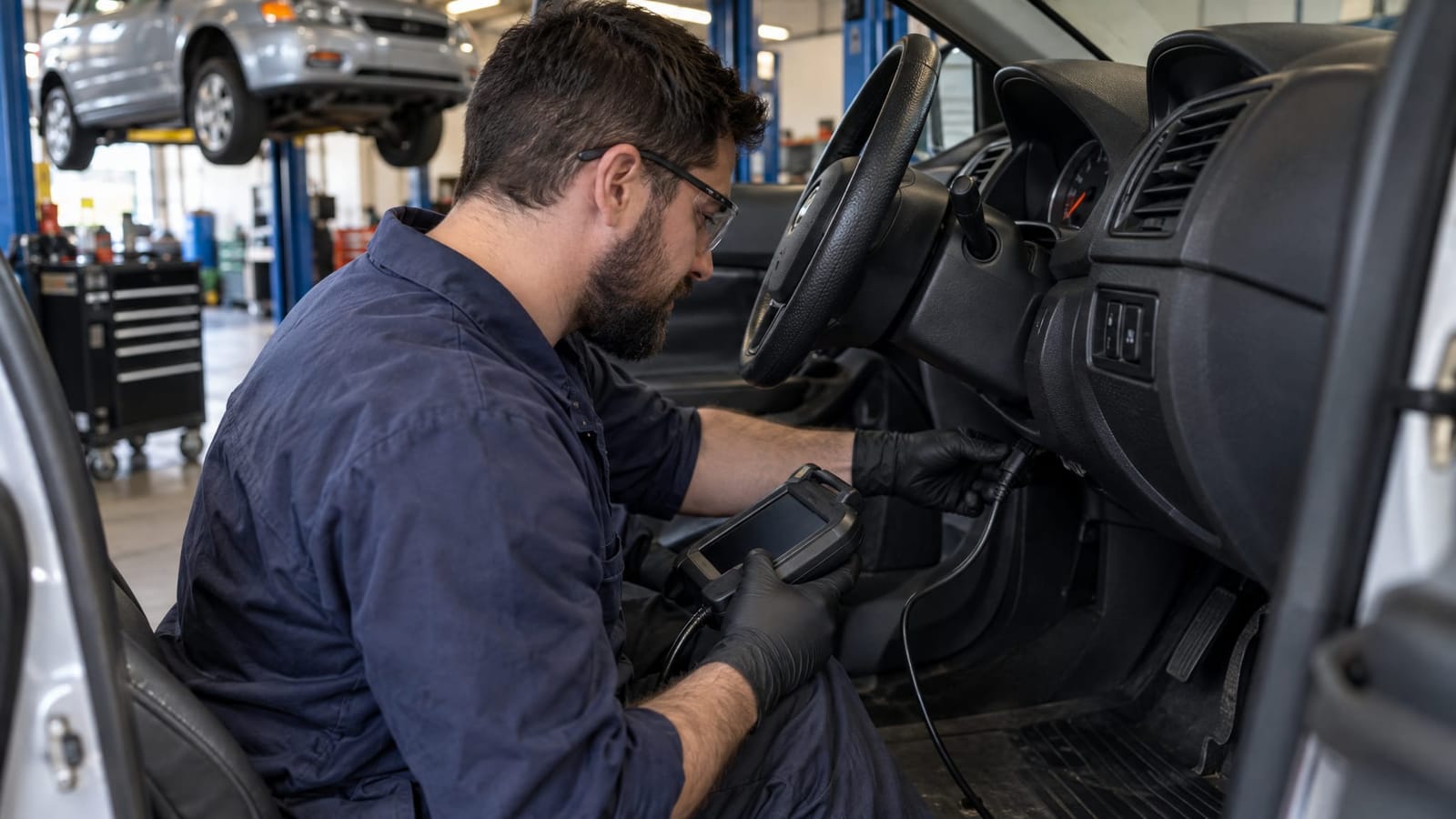
The process may include reviewing the symptom history, inspecting the relevant components, checking fluid levels or tire condition, retrieving fault codes, and testing the systems those clues identify. A road test may help reproduce a complaint when vehicle condition allows it.
A code scan is one step, not the entire diagnosis. Likewise, a visual inspection can identify obvious wear or leakage but may not reveal an intermittent electrical fault. Different symptoms require different tests.
Useful questions about the findings include:
- What finding connects the proposed repair to the symptom?
- Is the concern a safety issue, an operating problem, or routine maintenance?
- Could more than one issue be contributing?
- How will operation be checked after the repair?
Separating the repair that addresses the complaint from other maintenance items makes the explanation clearer. A worn component can need attention without being responsible for every symptom the vehicle has.
Deep Dive Topics
Warning-sign diagnosis becomes easier when related clues are considered together:
- Noises: Our guide to car noise diagnosis Forney TX explains grinding, squealing, and clunking, with attention to when each sound occurs.
- Dashboard warnings: The symbol, whether it flashes or stays on, and accompanying driving changes help establish urgency.
- Vibrations and handling: Separating braking, road-speed, acceleration, and idle symptoms helps distinguish tires, suspension, brakes, and drivetrain concerns.
- Smells and leaks: Timing, location, fluid behavior, and related temperature or braking changes provide more useful clues than color or odor alone.
- Engine, drivetrain, and AC performance: Precise descriptions of starting, shifting, power delivery, and airflow help focus testing even without a dashboard warning.
The Most Useful Clue Is a Clear Description
A warning sign points toward an investigation, not automatically toward an expensive repair. Start with its effect on safe operation, then note when it occurs and what else changes at the same time. A clear symptom history paired with targeted inspection is the practical path from “something feels wrong” to understanding the cause and the repair that addresses it.